
Ten years ago, I already wrote about the increasing regulation of holiday rentals in Spain. It started with giving the autonomous regions room to introduce their own rules. Many regions introduced registration requirements and, even then, I expressed the suspicion that registration would not only bring tourism-related obligations, but would ultimately also be followed by the levying of VAT.
Ten years later, we can conclude that holiday rentals have ended up in a true legal rollercoaster. National rules, regional rules and municipal restrictions have been layered on top of each other. Sometimes they complement one another, sometimes they appear to contradict each other, and sometimes the question even arises as to which authority is actually competent. The result is enormous legal uncertainty for private owners who rent out their property in Spain, either wholly or partially. Many publications preceded this one:
Additional restrictions on vacation rentals II
Renting out properties in Spain-part 1
Holiday Homes Rental Act Valencia
Further Restrictions on Holiday Rentals
Spanish Supreme Court strikes down national NRA register for holiday rentals
With the brand-new Real Decreto-ley 26/2026 of 29 September 2026, another series of far-reaching measures has now been introduced. In this article, I will limit myself to the VAT aspects.
Subject to VAT of 1 December 2026
Until now, holiday rentals have in principle been exempt from VAT. Only where services characteristic of the hotel sector are provided is 10% VAT charged.
From 1 December 2026, the rental of a furnished property for a maximum of 30 nights to the same tenant will, in principle, be subject to 10% VAT.
This means that, from 1 December, the tax criterion will no longer primarily revolve around whether hotel-type services are provided. The duration of the stay itself becomes decisive.
A major tax change introduced through emergency legislation
Once again, the legislative form chosen is striking. This is not an ordinary legislative procedure, but a Real Decreto-ley, based on what the government considers to be an extraordinary and urgent necessity.
The government extensively justifies this urgency by referring to the problems in the Spanish housing market and describes the current situation as a housing crisis requiring exceptional measures. At the same time, the text itself acknowledges that housing policy largely falls within the powers of the autonomous regions and municipalities.
That makes the chosen method even more remarkable. A fundamental change in the tax treatment of hundreds of thousands of rental situations is being introduced with a transitional period of only two months, in response to a situation in the rental market that has existed for as long as I have lived in Spain, 26 years. Nothing new, in other words, but nevertheless an excuse to once again bypass the normal parliamentary legislative process by means of an emergency decree.
As far as can be seen from the published text, no separate economic impact assessment has been included examining, for example:
- How many landlords will be affected by this VAT obligation;
- What effect a price increase of up to 10% may have on Spain’s competitive position as a holiday destination;
- How many private owners may decide to stop renting out their property;
- What on earth this has to do with a “housing crisis” in the national housing market;
- How charging VAT is supposed to solve a housing problem.
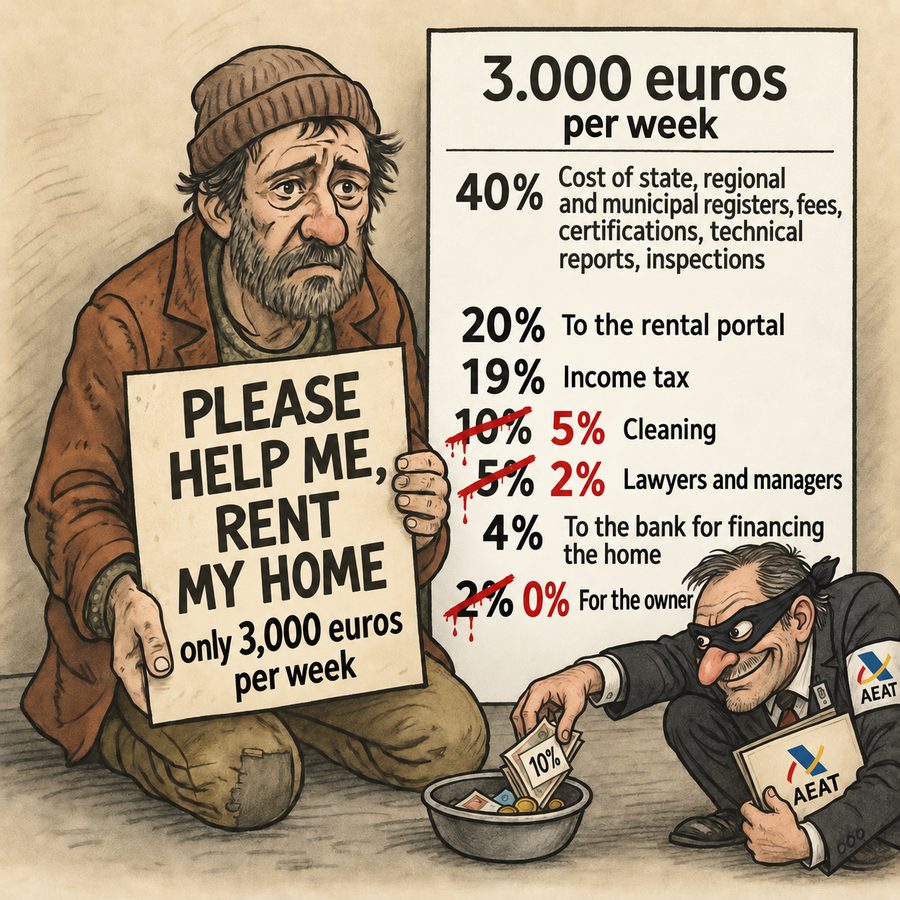
The legislator therefore opts for a far-reaching tax measure without substantiation or any real connection with the stated purpose of the regulation. We will have to discover afterwards how the market reacts, but it certainly creates the strong impression that the housing crisis is being used mainly as an argument to impose an additional tax burden on tourists.
But one thing is clear: taxation does not create additional homes. It mainly changes the distribution of costs between owner, tenant and government.
For a country in which holiday rentals form an important part of the tourism infrastructure, it is therefore difficult to predict what consequences this measure will ultimately have for prices, supply and competition with other Southern European holiday destinations.
What should a landlord do now?
For owners who fall within this regime, their tax position changes fundamentally.
A landlord carrying out VAT-taxable rental activities is treated as a business operator for VAT purposes. In principle, the Agencia Tributaria requires registration where a VAT-taxable rental activity is carried out. In addition, the VAT due must be declared and paid through the applicable VAT returns.
From 1 December, many foreign owners who until now only filed an annual IRNR return in respect of their Spanish rental income will therefore suddenly also have to maintain a VAT administration.
This includes, among other things:
- VAT registration;
- Application of 10% VAT to the rental price;
- Correct invoicing;
- Administration of VAT received and paid;
- Periodic filing of modelo 303;
- Assessment of which costs and input VAT are deductible;
- Coordination of the VAT administration with the non-resident income tax return.
Penalties
Anyone who fails to declare or pay the VAT due falls under the normal Spanish tax penalty regime. Failure to pay tax which should have resulted from a correctly filed return, constitutes a tax infringement. Depending on the circumstances, the penalty for a minor infringement may start at 50% of the unpaid amount, with higher percentages applying in more serious cases.
But this is where the questions only begin
At first sight, the new regime appears simple: 10% VAT on short-term rentals. In practice, however, this is where the discussion really begins.
The advantage of VAT liability is that, in principle, it may also create a right to deduct VAT input. Costs directly related to taxable rental activity may therefore receive a different tax treatment from before. Particularly in the case of a holiday home, however, complicated situations immediately arise.
What happens, for example, with a property that is rented out for three months of the year and used privately by the owner for the remaining nine months?
VAT legislation contains restrictions on goods and services used both for business and private purposes. Article 95 of the Ley del IVA provides, among other things, that VAT is in principle not deductible on goods and services that are not directly and exclusively allocated to economic activity. The law expressly refers to goods that are used alternately for business and private purposes.
And that is where an almost endless list of practical questions begins.
Is VAT on maintenance fully deductible when the property is only rented out for part of the year? How should electricity, cleaning, repairs, furniture, internet, insurance and management costs be treated? What happens with major renovations? How is private use valued? What adjustment must be made if the use of the property changes later? What happens when the property remains vacant for part of the year?
It will also have to be determined exactly how this new VAT administration will interact with the existing declaration of income by non-residents through the IRNR.
For foreign owners there is an additional practical issue: communication with the Spanish tax authorities is becoming increasingly electronic. In practice, many owners will therefore need a valid electronic identification method or digital representation to process notifications, returns and any communications from the tax authorities in time.
On all these points, further practical guidance from the Agencia Tributaria will be needed in the coming months.
Our advice: do not wait until December!
Lex Foris will, as we have done throughout the many changes concerning holiday rentals in recent years, continue to monitor and, where necessary, defend the legal position of landlords.
In addition, for existing clients we can prepare and handle the VAT registration and ongoing VAT administration relating to the rental activity, so that they can comply with the new obligations from 1 December onwards.
Do you rent out your Spanish property for periods of up to 30 nights? Contact us in good time. From 1 December, not only will the tax rate change, but your entire tax administration.
Roeland van Passel